

Cloud Computing in AI 2026: 7 Trends to Watch online. The public cloud market is undergoing a fundamental transformation, with global spending surpassing $1 trillion. However, enterprise cloud strategy is no longer driven by simple “lift-and-shift” server migrations.
The convergence of autonomous AI workloads, strict data sovereignty laws, and runaway infrastructure bills has altered digital architecture. Unchecked cloud sprawl and idle GPU clusters are exposing the limits of legacy IT models.
For CTOs, cloud architects, and engineering leaders, staying competitive requires looking past vendor hype. This briefing examines the 7 critical cloud trends, complete with architectural tradeoffs, practical examples, and actionable strategies to help guide your organization forward.
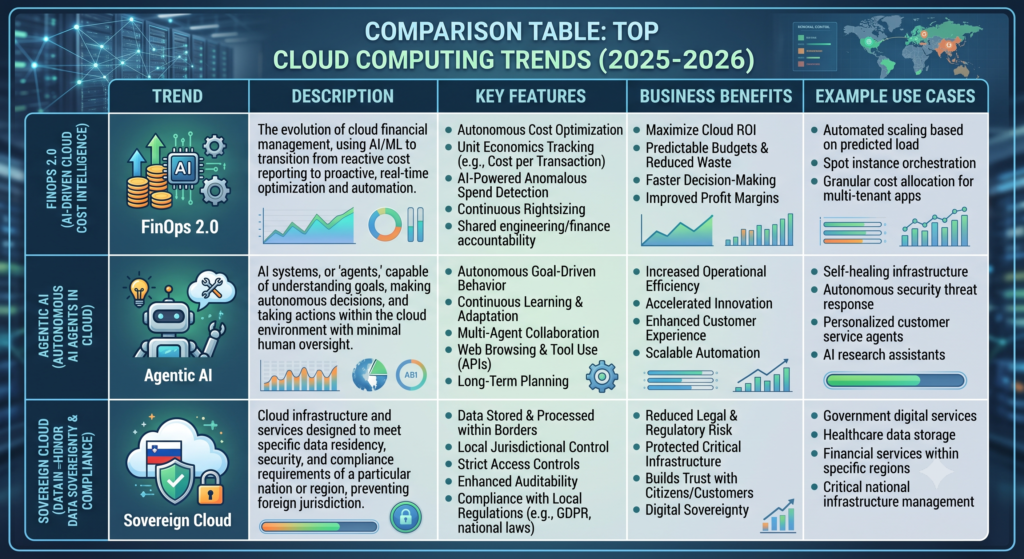
Strategic Trends Matrix
| Trend | Primary Driver | Core Business Impact | Strategic Priority |
| 1. Agentic AI & GPU Infrastructure | Autonomous AI models & LLM inference pipelines | High compute spend; specialized hardware bottlenecks | High |
| 2. FinOps 2.0 & Dynamic Governance | Unchecked cloud waste & unmonitored AI overruns | Margin protection; engineering budget accountability | Urgent |
| 3. Strategic Cloud Repatriation | High data egress fees & predictable base workloads | Hybrid architecture shifts; bare-metal hosting | Medium |
| 4. Edge AI & Distributed Compute | Sub-10ms latency requirements for real-time IoT | Instant local execution; reduced bandwidth load | High |
| 5. Sovereign Cloud & Localization | Geopolitical mandates & regional privacy laws | Regulatory compliance; localized data isolation | Critical (Global Ops) |
| 6. Securing Serverless & Low-Code | Low-code proliferation & microservice API sprawl | Expanded attack surface; shadow IT vulnerabilities | High |
| 7. Carbon-Aware Green Computing | Corporate ESG mandates & power grid limits | Audit compliance; compute scheduling efficiency | Medium |
Trend 1: Agentic AI and GPU-Optimized Cloud Infrastructure
The Shift from Standard VMs to AI Workloads
Traditional CPU-bound virtual machines are no longer the primary driver of public cloud revenue growth. As enterprise software shifts from static web applications to Agentic AI—autonomous models that reason, plan, and execute multi-step API workflows—cloud demand has pivoted toward specialized GPU (e.g., NVIDIA H100/B200) and NPU clusters.
Hosting continuous inference pipelines and fine-tuning domain-specific models requires high-density compute. However, this shift introduces severe operational friction:
- Accelerator Scarcity & Reservation Lock-in: On-demand access to high-tier accelerators remains tight, forcing enterprises into costly multi-year reserved capacity commitments.
- Idle Hardware Waste: Running dedicated GPU instances for intermittent agent tasks results in massive financial waste during off-peak hours.
- Context Window Egress Overhead: Moving massive multi-gigabyte context windows between object storage and processing nodes creates severe latency and unexpected network costs.
+-------------------------------------------------------------------------+
|                  AI INFRASTRUCTURE OPTIMIZATION PATHWAY                 |
+-------------------------------------------------------------------------+
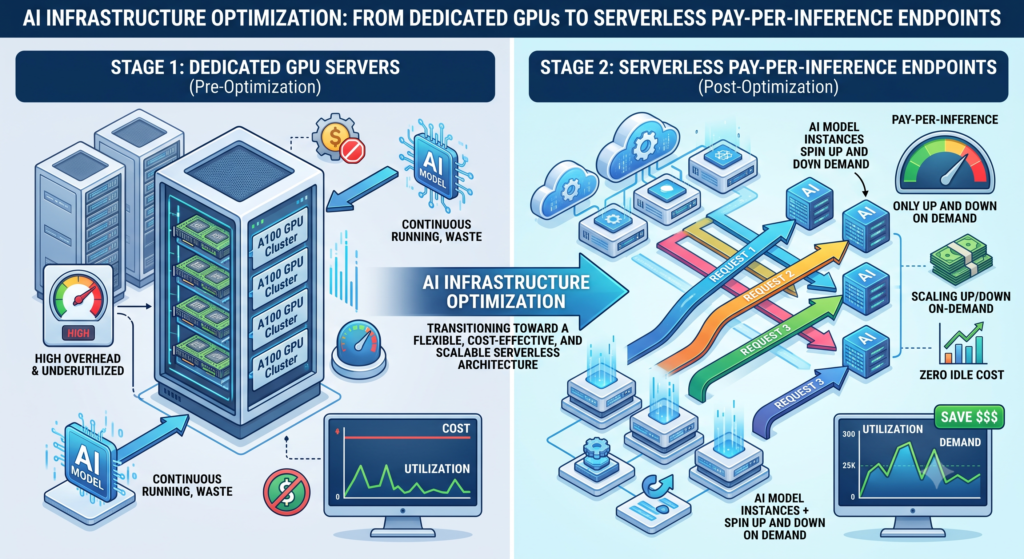
|  Legacy Model:     [ Always-On Dedicated GPU ]  --> High Idle Cost      |
|  Modern Approach:  [ Serverless GPU Endpoint ]  --> Pay-Per-Inference     |
|  Optimization:     [ Quantized Local Models  ]  --> Lower VRAM Footprint |
+-------------------------------------------------------------------------+
Real-World Example
A financial analytics enterprise running real-time fraud detection replaced always-on dedicated GPU instances with dynamic serverless inference endpoints running optimized, quantized models via vLLM. This reduced their monthly AI infrastructure spend by 62% without impacting inference latency.
Strategic Action Item for CTOs: Conduct an immediate audit of all running AI instances. Transition intermittent testing environments to dynamic pay-per-inference endpoints and enforce auto-termination policies on idle GPU nodes.
Trend 2: FinOps 2.0—From Cloud Cost Tracking to Automated Governance
Why Basic Cloud Cost Monitoring Is Failing
First-generation FinOps relied on static monthly dashboards and post-facto billing reviews. In a modern cloud ecosystem running auto-scaling microservices and dynamic AI workloads, a monthly invoice review acts as an autopsy—identifying budget overruns weeks after the capital has been spent.
Enterprises waste an estimated 29% of public cloud spending on idle resources, oversized instances, and abandoned storage volumes.
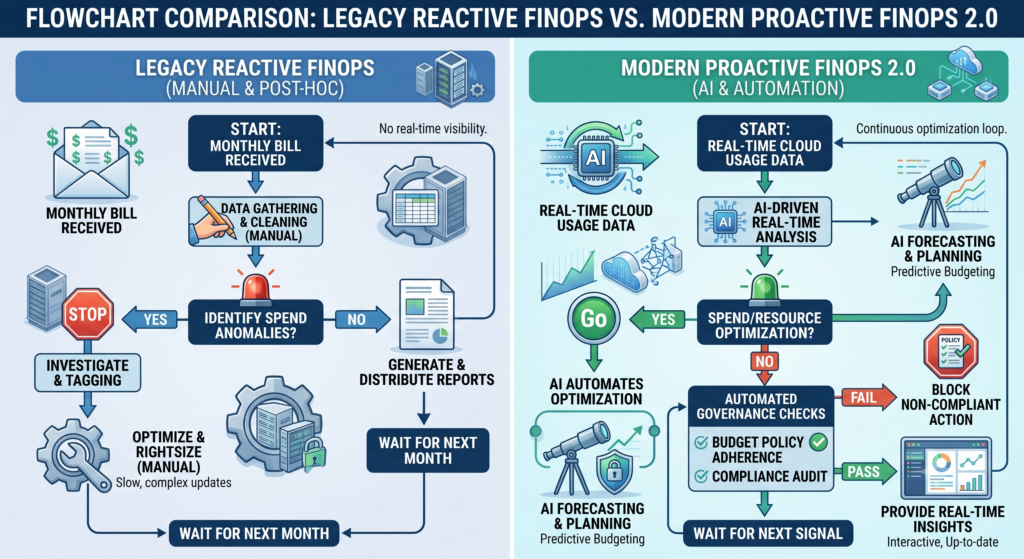
Legacy FinOps (Reactive):   Monthly Invoice  --> Finance Audit   --> Belated Budget Cut
FinOps 2.0 (Proactive):    Real-Time eBPF   --> Policy Engine   --> Automated Remediation
Implementing an Engineering-Led FinOps Culture
FinOps 2.0 embeds financial guardrails directly into the Software Development Lifecycle (SDLC). Engineering teams leverage Policy-as-Code within CI/CD pipelines to block non-compliant, un-tagged infrastructure from deploying to production.
| Feature | FinOps 1.0 (Legacy) | FinOps 2.0 (Modern) |
| Reporting Cadence | End-of-month financial statements | Real-time / Streamed telemetry |
| Primary Ownership | Finance & Procurement teams | DevOps, SREs, & Platform Engineers |
| Remediation Action | Manual budget meetings | Policy-driven automated resource termination |
| Core Focus | Reserved Instances & Savings Plans | Unit economics, architecture efficiency, & AI spend |
Strategic Action Item for CTOs: Embed cost-linting scripts directly into your deployment pipelines. Mandate that every infrastructure PR includes an estimated cost delta before approval.
Trend 3: Strategic Cloud Repatriation & Hybrid Balance
The Myth of 100% Public Cloud Efficiency
The assumption that every enterprise workload belongs in the public cloud has reached its limits. Organizations with mature, highly predictable baseline workloads are finding that public cloud flexibility comes with a perpetual price premium.
Selective cloud repatriation—moving steady-state workloads off public cloud platforms back to private clouds, colocation facilities, or bare-metal hosters—is gaining momentum. The primary driver is rarely raw compute cost, but data egress taxation. Cloud providers charge steep fees to transfer data out of their networks, penalizing multi-cloud and hybrid setups.
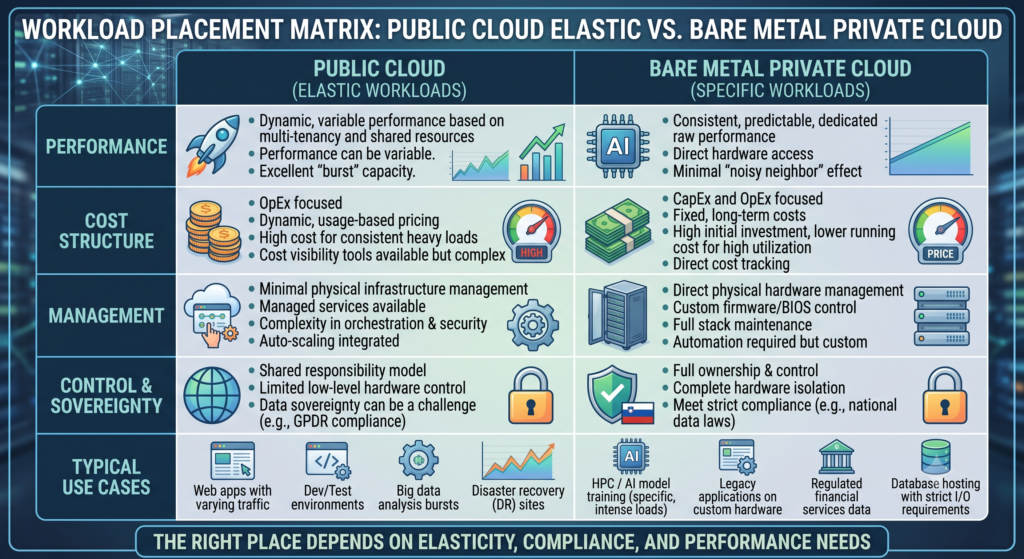
+-----------------------------------------------------------------------+
|                       WORKLOAD PLACEMENT MATRIX                       |
+-----------------------------------------------------------------------+
|  Public Cloud (Elastic / Variable)   Private / Bare-Metal (Predictable)|
|  ---------------------------------   ---------------------------------|
|  * Seasonal E-commerce Spikes         * Core Relational Databases       |
|  * R&D Sandbox Environments           * High-Volume Log Processing      |
|  * Global Event-Driven APIs           * Steady-State SaaS Backbones     |
+-----------------------------------------------------------------------+
Real-World Example
A high-volume SaaS logging platform processing over 50 Terabytes of telemetry daily repatriated its core storage and search clusters from public cloud instances to dedicated bare-metal servers. By eliminating cloud data egress fees and storage markup, they reduced total operational expenditure by $1.2 million annually.
Strategic Action Item for CTOs: Evaluate your cloud architecture using a two-axis matrix: Workload Predictability vs. Data Transfer Volume. Any workload with low variability and high data output should be modeled for potential private cloud or bare-metal hosting.
Trend 4: Edge AI and Distributed Compute
Moving Intelligence from Data Centers to Local Nodes
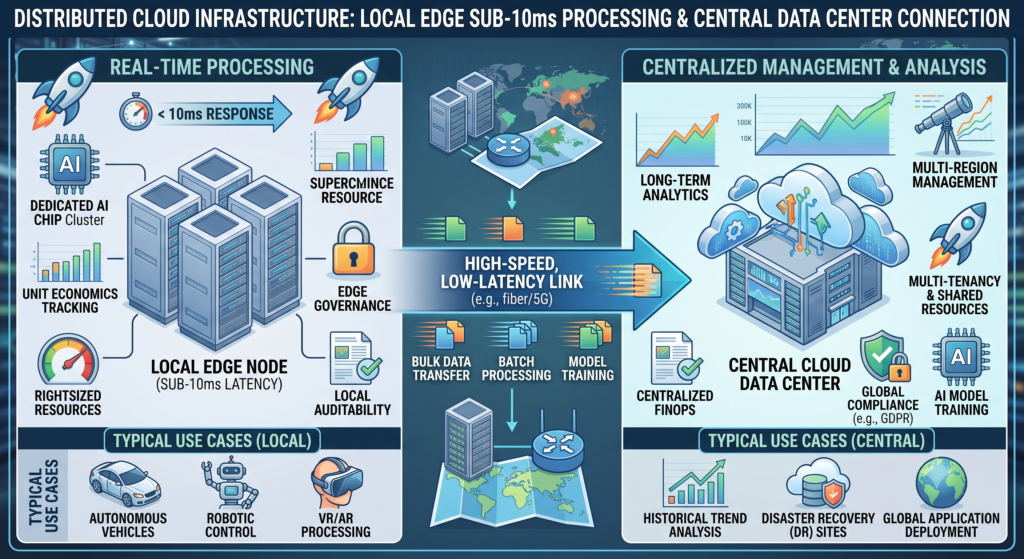
Centralized data centers are physically too distant to serve applications requiring sub-10 millisecond execution. Autonomous manufacturing lines, robotic medical devices, and smart grids cannot tolerate the round-trip latency of transmitting raw telemetry to a distant public cloud region.
[ Central Cloud Data Center ]
             ^
             | (Aggregated Metadata & Model Updates)
             v
 [ Local Edge Gateway / Node ]
             ^
             | (Sub-10ms Local Execution)
             v
 [ IoT Sensors / Actuators / Cameras ]
Edge AI shifts trained neural network models directly onto local gateways and specialized edge edge devices. The local node processes raw sensor data, executes instantaneous decisions, and transmits only compressed metadata back to the central cloud for long-term storage and model refinement.
Practical Example
An automated automotive assembly plant uses vision-based AI edge nodes directly on the factory floor. The edge nodes inspect weld quality in under 8 milliseconds, halting defective robotic arms instantly without relying on an external cloud connection.
Strategic Action Item for CTOs: Audit your IoT and real-time processing pipelines. Shift non-critical data processing out of the central cloud by deploying lightweight containerized inference models to edge hardware.
Trend 5: Sovereign Cloud & Data Localization Mandates
Navigating Complex Regional Compliance Laws
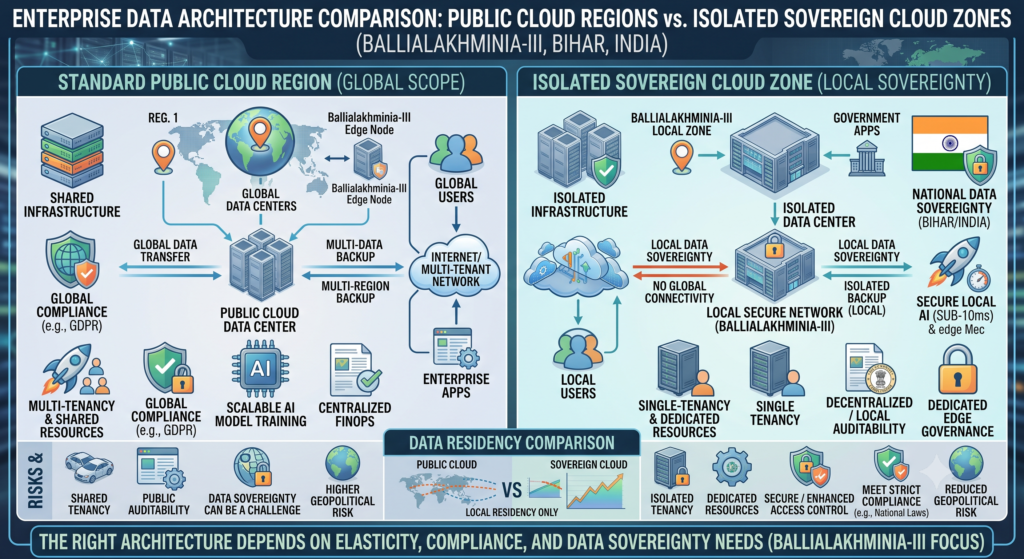
Geopolitical changes and strict digital sovereignty mandates (such as the EU NIS2 directive and global localized data laws) have made physical data location a critical compliance issue.
Global enterprises can no longer freely move customer data across international borders. Regulators now enforce strict guidelines regarding:
- Data Residency: Where raw customer data physically resides at rest.
- Jurisdictional Sovereignty: Which foreign legal bodies can subpoena or access that data.
- Operational Isolation: Requiring cloud data centers to be managed exclusively by local citizens holding security clearances.
                      GLOBAL ENTERPRISE DATA ARCHITECTURE
                                       |
      +--------------------------------+--------------------------------+
      |                                                                 |
[ Standard Public Cloud Region ]                       [ Sovereign Cloud Zone ]
* Global API Endpoints                                 * Strict Physical Air-Gap
* Standard Access Control                              * Local Citizen Operators Only
* Commercial Data Processing                           * Sovereign Key Management
Architectural Options for Global Enterprises
To maintain compliance without duplicating engineering efforts, enterprises are adopting Sovereign Landing Zones. Major providers now offer dedicated sovereign environments (such as the AWS European Sovereign Cloud or Microsoft Cloud for Sovereignty) that maintain standard API compatibility while enforcing strict legal, physical, and operational isolation within local borders.
Strategic Action Item for CTOs: Map your global data flows against emerging regional privacy laws. Isolate localized user data into dedicated sovereign landing zones to prevent regulatory penalties.
Trend 6: Securing Serverless Architectures & Low-Code Platforms
The Hidden Security Risks of Low-Code Proliferation
The rapid growth of serverless microservices and low-code internal application builders has democratized software development. Business units can now construct custom tools, automated webhooks, and data pipelines without waiting for centralized engineering support.
However, this democratization creates Shadow Cloud Infrastructure. Non-technical users often expose production databases through misconfigured API endpoints, hardcoded credentials inside low-code platforms, and over-privileged integrations.
              UNGOVERNED LOW-CODE FLOW (HIGH RISK)
  [ Citizen Dev ] ---> [ Low-Code Builder ] ---> [ Exposed Production DB ]
                                                     (Over-Privileged Key)

              SECURED API-GATEWAY FLOW (ZERO TRUST)
  [ Citizen Dev ] ---> [ Managed API Gateway ] ---> [ Scoped Lambda / Function ] ---> [ DB ]
                                                        (Least-Privilege Role)
Zero-Trust Security for Ephemeral Environments
Securing dynamic, serverless environments requires shifting from traditional network perimeters to Identity-Centric Zero Trust:
- Ephemeral Credentials: Eliminate static API keys. Enforce short-lived OAuth tokens for all internal service communications.
- Automated Least-Privilege IAM: Use automated analysis tools to inspect runtime execution logs and strip unnecessary read/write permissions from cloud roles.
- Managed API Gateways: Route all low-code and serverless traffic through a central gateway equipped with automated rate limiting and Web Application Firewall (WAF) protections.
Strategic Action Item for CTOs: Implement automated API discovery tools across your cloud environments to identify and secure unmonitored shadow endpoints created by low-code development platforms.
Trend 7: Sustainable Cloud Computing & Carbon Footprint Optimization
ESG Compliance Meets Infrastructure Planning
Corporate Sustainability Reporting Directives (CSRD) and global ESG standards have turned cloud energy consumption into an executive-level metric. Data centers are massive energy consumers, and enterprise cloud customers are held accountable for Scope 3 emissions generated by their hosted workloads.
While major cloud vendors compete on Power Usage Effectiveness (PUE) metrics, reducing actual carbon output depends on how engineering teams schedule and architect their workloads.
+-------------------------------------------------------------------------+
|                  CARBON-AWARE WORKLOAD SCHEDULING                       |
+-------------------------------------------------------------------------+
|  High-Carbon Window:  [ Solar Low / Grid on Fossil ] --> Defer Batch    |
|  Low-Carbon Window:   [ Solar Peak / Clean Grid    ] --> Run ETL / Train |
+-------------------------------------------------------------------------+
Green Coding and Carbon-Aware Scheduling
Forward-thinking IT teams are adopting Carbon-Aware Compute Pipelines:
- Temporal Workload Shifting: Scheduling non-urgent, high-compute batch jobs (e.g., LLM fine-tuning, nightly data warehouse ETL) to run during hours when the local power grid relies predominantly on renewable energy.
- Geographic Workload Shifting: Routing flexible compute jobs to regional cloud data centers operating on cleaner energy mixes.
Strategic Action Item for CTOs: Integrate carbon-aware APIs into your batch job schedulers to automatically shift heavy compute workloads to regions and times with the lowest carbon intensity.
Frequently Asked Questions
What is cloud repatriation, and why is it trending?
Cloud repatriation is the strategic process of moving applications, databases, or workloads away from public cloud platforms back to local data centers, private clouds, or bare-metal hosters. It is trending because enterprise leaders want to eliminate unpredictable cloud costs, high data egress fees, and performance issues associated with mature, steady-state workloads that no longer require public cloud elasticity.
What is the primary difference between FinOps 1.0 and FinOps 2.0?
The main difference is that FinOps 1.0 relies on reactive post-facto billing audits, while FinOps 2.0 embeds proactive, automated cost controls directly into software pipelines. FinOps 2.0 uses Policy-as-Code within CI/CD deployment workflows to prevent over-provisioned or un-tagged resources from deploying, giving engineers real-time visibility into cost impact before infrastructure is provisioned.
How does a Sovereign Cloud differ from a standard public cloud region?
A Sovereign Cloud enforces strict legal, physical, and operational data isolation within a specific jurisdiction, whereas a standard public cloud region only provides logical separation. Sovereign Clouds operate under local national laws, keep data physically air-gapped within regional borders, and restrict data center operations exclusively to background-checked local citizens to prevent foreign subpoena access.
Why is Edge AI replacing centralized public clouds for IoT workloads?
Edge AI replaces central cloud processing because sending massive streams of raw IoT data to distant data centers introduces network latency and high bandwidth costs. By processing raw data directly on local devices, Edge AI enables instantaneous, sub-10 millisecond decision-making while transmitting only compressed summary data back to the central cloud.
Read about What is the best AI tool for students in 2026? – nowstrends.com
AI Trends in 2026: 10 Breakthrough Technologies Changing the Future – nowstrends.com
Google Gemini vs ChatGPT (2026): Which AI Assistant Is Actually Better? – nowstrends.com
Cloud computing documentation – Cloud Computing | Microsoft Learn
Hostinger vs AWS (2026): Which Hosting Is ACTUALLY Better for Beginners? – nowstrends.com
[…] Read about Cloud Computing in AI 2026: 7 Trends to Watch online – nowstrends.com […]
[…] Read about Cloud Computing in AI 2026: 7 Trends to Watch online – nowstrends.com […]
[…] Cloud Computing in AI 2026: 7 Trends to Watch online – nowstrends.com […]
[…] Cloud Computing in AI 2026: 7 Trends to Watch online – nowstrends.com […]
[…] Cloud Computing in AI 2026: 7 Trends to Watch online – nowstrends.com […]
[…] Cloud Computing in AI 2026: 7 Trends to Watch online – nowstrends.com […]
[…] Cloud Computing in AI 2026: 7 Trends to Watch online – nowstrends.com […]